Call for papers
Call for Abstracts: Novelty and Inequalities in Science
Although novelty is implicitly ubiquitous in science, it has recently itself become a new object of research within the science of science. What lies behind the current emphasis on novelty in science? What counts as new, and who gets to decide? The Centre for Science, Technology, and Society Studies at the Institute of Philosophy of the Czech Academy of Sciences invites prospective participants to submit abstracts for the international research symposium Novelty and Inequalities in Science, which will take place in Prague on 8–9 October 2026. Contributions may be submitted until 30 June 2026.
The symposium aims to provide a shared platform for reflecting on the recent attention devoted to novelty research and for discussing the relationship between novelty and inequalities in science. We welcome empirically grounded contributions using computational, network, quantitative, or qualitative methods in fields such as the science of science, research on research, scientometrics, and sociology of science.
Participants are invited to share both completed and work-in-progress research in the form of non-archival presentations and discussion.
Abstracts of 150–300 words may be submitted by 30 June 2026.
More information, the latest updates, and submission guidelines
Contact:
- 23. 6. 2026
- Call for papers

Call for papers: Climate Crisis and the Question of Justice
The third edition of the international interdisciplinary conference Climate Crisis and the Question of Justice will welcome experts whose work focuses on the issues of climate crisis and just transition, adaptation measures and policies, the status and conditions of climate activists, the impacts of climate change on society, and theoretical reflections on these topics in the social sciences and humanities. Deadline for applications is 31 July 2026.
The international conference provides a forum for interdisciplinary dialogue on one of the most pressing challenges of our time: the multifaceted impacts of the climate crisis amid the current polycrisis. This includes, among other things, ongoing geopolitical conflicts, energy transition, shifting global inequalities, and the growing environmental burden. The overarching goal of the conference is to promote critical reflection on the climate crisis as a complex phenomenon that is fundamentally transforming the relationships between society, economy, politics, and the environment. Special attention will be given to issues of climate justice in the context of current crises, including the tension between climate policy and the social impacts of the transition, conflicts surrounding its distribution, and the rise of political backlashes such as populism or resistance to environmental measures.
We welcome contributions particularly in the following thematic areas:
- Climate justice in the context of a polycrisis: the interconnection of the climate crisis with war, the energy transition, migration, security, and changes in asylum regimes;
- Conflicts and political dynamics of transformation: social and regional impacts of transformation, tensions between climate and social policy, backlash, populism, and politicization of climate measures;
- Political economy and global inequalities: financing the transition (debt, reparations, destruction), global asymmetries, changes in supply chains, issues of self-sufficiency, resilience, and security;
- Power, governance, and space: the climate crisis in undemocratic regimes, participation and its limits, land ownership, land-use planning;
- Affective, cultural, and imaginative dimensions of the climate crisis: climate anxiety, grief, and fatigue; pollution and toxicity; as well as imagined futures in the context of the climate crisis.
The form to submit a paper can be found under this link
- 1. 6. 2026
- Call for papers
CfP | Foucault at 100: Echoes and Encounters in Central and Eastern Europe
We are extending the call for papers for the conference Foucault at 100: Echoes and Encounters in Central and Eastern Europe, which will be held in Prague (1–2 June 2026) and Warsaw (4–5 June 2026). The 100th anniversary of Foucault’s birth offers a unique opportunity to reflect on past contributions, current developments, and future directions of Foucauldian approaches to CEE issues. The deadline for proposals is 31 December 2025.
The first two days will take place in Prague, followed by a break before continuing in Warsaw. Prague will host participants presenting papers on epistemology, philosophy, gender, and aesthetics, while Warsaw will focus on discussions surrounding power, governmentality, and ethics. Detailed information.
Deadline for proposals is 31 December 2025.
Host Institutions
The Institute of Philosophy of the Czech Academy of Sciences
Centre français de recherche en sciences sociales en Prague
Centre de civilisation française et d'études francophones en Pologne (CCFEF)
Organizing Committee
Mateusz Chmurski, Isabel Jacobs, Jiří Růžička, Radosław Szymański, Laurent Tatarenko
Contact Email:
- 1. 12. 2025
- Call for papers

CfP for the XV International Symposium on the Bohemian Reformation and Religious Practice
We are pleased to invite proposals for papers for the XV International Symposium on the Bohemian Reformation and Religious Practice, to be held in Prague on 18–19 June 2026, on the theme: “The Long Bohemian Reformation, European Universities, and Scholarly Disputations.” The symposium will examine the intersections between the Long Bohemian Reformation and European academic life, with a particular focus on the role of disputations. The deadline for submitting contributions is January 31, 2026.
For full details, including suggested topics and submission guidelines, please take a look at the attached Call for Papers.
Proposals (abstracts of 200–300 words) should be submitted to
Notification of acceptance will be sent by the end of February.
- 30. 9. 2025
- Call for papers
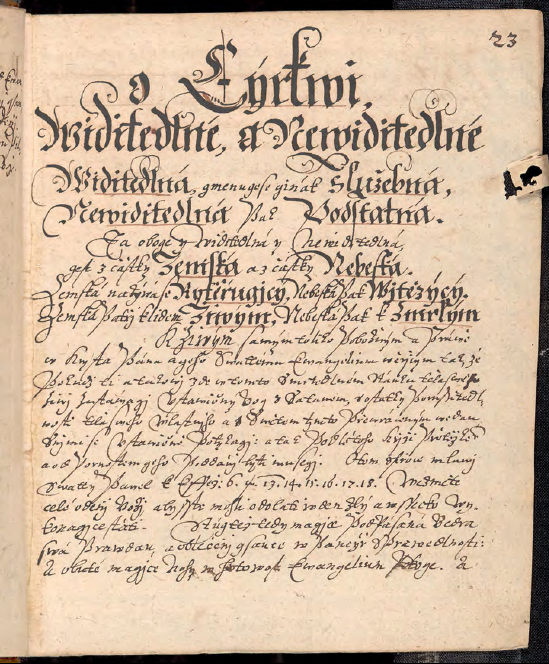
CfP: Manuscript Practices and the Making of Exile Communities in the Early Modern Period
The conference will focus on the role of manuscript culture in exile communities of diverse religious backgrounds during the early modern period, with a particular emphasis on the 1620s and 1630s. Specifically, it will examine how the written word was used to sustain, transmit, and reshape collective and individual identities amid the pressures of displacement and religious conflict. The discussion will cover the various forms of manuscript production, such as personal notebooks and records, collections of sermons, prophetic and chiliastic writings, polemical tracts and historical compilations, all situated within institutional frameworks and domestic contexts. Particular attention will be given to the act of copying, which will be considered not only as a practical means for the transmission of texts in environments with limited access to print, but also as a practice with symbolic significance and economic value. Copies could serve as a reaffirmation of tradition, a means and strategy for coping with the loss of home and faith. Furthermore, commissioning copies could function as a form of social support, providing employment and sustenance for those in exile who had lost their livelihoods. By examining these practices, the conference aims to shed light on the specific textual corpora of exile and broader issues of communication, such as memory, authorship and textual identity in forced migration situations.
Please submit paper proposals together with a brief CV by 30 October 2025 to:
- 9. 9. 2025
- Call for papers
Call for Papers | Betweonum: Brooklyn–Prague Forum for Philosophy of Art
We invite proposals for the second edition of the conference on the philosophy of art, subtitled Resisting Divides: Contemporary Philosophy of Art. The event aims to create “in-between spaces” that enable resistance to divisions in contemporary approaches to art. It will address both the divide between analytic and continental philosophy, and divide between artworld practitioners and academic philosophers. The deadline for submissions is September 15, 2025.
Resisting the Divide: Part II (Betweonum in Prague)
Second conference of Betweonum: Brooklyn–Prague Forum for Philosophy of Art
Host: Institute of Philosophy, Czech Academy of Sciences, Prague
Venue: Dominikanska 8, cultural space in Old Prague Town
Dates: November 21-22, 2025
To submit anonymized abstract of 300-400 words BY September 15, 2025: please use https://forms.gle/8E2DZ6PE1NjPvmvS8 or email to:
Notification of acceptance by September 30, 2025.
This conference, to be held in Prague, Czechia, is Part II of Resisting Divides: Contemporary Philosophy of Art that was held at Brooklyn College, NY, in October 2024 and co-organized by Dena Shottenkirk and Martin Nitsche. Here we established Betweonum: Brooklyn–Prague Forum for Philosophy of Art – a group of philosophers and other scholars, curators, and artists who seek to establish in-between spaces that enable resistance to the divides in contemporary approaches to art.
Since then, there has been an increasing movement by various philosophers toward eradicating the western world’s divide between continental and analytic philosophy as seen in the creation of reading groups, published work, and general trends. To be specific regarding the latter, the philosophy of art in the analytic tradition has continued to undergo a revolution by aligning more closely with perception and thus including in its parameters historical, phenomenological, and embodied psychological concerns. Continental philosophers of art have begun to reference science while still focused on the phenomenology of first-person experience. It shouldn’t be a surprise that it is in the philosophy of art where this revolution is occurring because it is this discipline that dovetails with other disciplines such as epistemology, philosophy of mind, politics, and ethics. Thus, it is in the philosophy of art that this divide between the two philosophical traditions can best be resolved.
There is also a second divide that this conference will address, and that is the glaring division between academic philosophers and “on the ground” practitioners in the artworld e.g., curators, art writers, and artists themselves. This, too, is a difficulty, as the ongoing frustrations of a stalemated postmodernism cannot be solved without a consensus between these two groups, thus calling for a need to think of art outside the confines of modernism’s stylistic revolutions and formalist issues, as well as outside the traditional analyses provided by the two camps of philosophers. This cannot be done without an open and critical exchange of viewpoints, and it is this that the conference will provide.
Thus, this conference will address both of those divides: The analytic/continental divide and divide between artworld practitioners and academic philosophers.
We welcome submissions on these possible questions:
1. How does the increase in time-based art (e.g., performance, video) increase an analysis that draws on phenomenology?
2. Does AI have a useful role in artmaking? And can it replace artists altogether?
3. How is the “snapshot” representational theory inadequate to an analysis of art, and why might saliency maps or Gibson’s notion of affordances be more useful?
4. What is the epistemological function of art?
5. How does the monetary role in art affect both the artist and the perceiver of art?
6. How do the mechanics of seeing (e.g., gist perception, peripheral vision, etc.) affect how we experience art?
7. How does the practice of making art relate to the first-person experience?
8. What role does empathy play in art, and how do affordances explain that?
9. Are there specific non-western traditions that provide a better explanatory solution for the role of art than have the competing paradigms of continental and analytic
10. In what way does philosophy play a role in art itself?
We welcome your participation and look forward to your contributions. Papers should not extend over 30 minutes. Additional Q & A are 15 minutes.
Food will be served. There is no conference fee. Alas, organizers cannot assist with accommodations and travel.
- 13. 8. 2025
- Call for papers
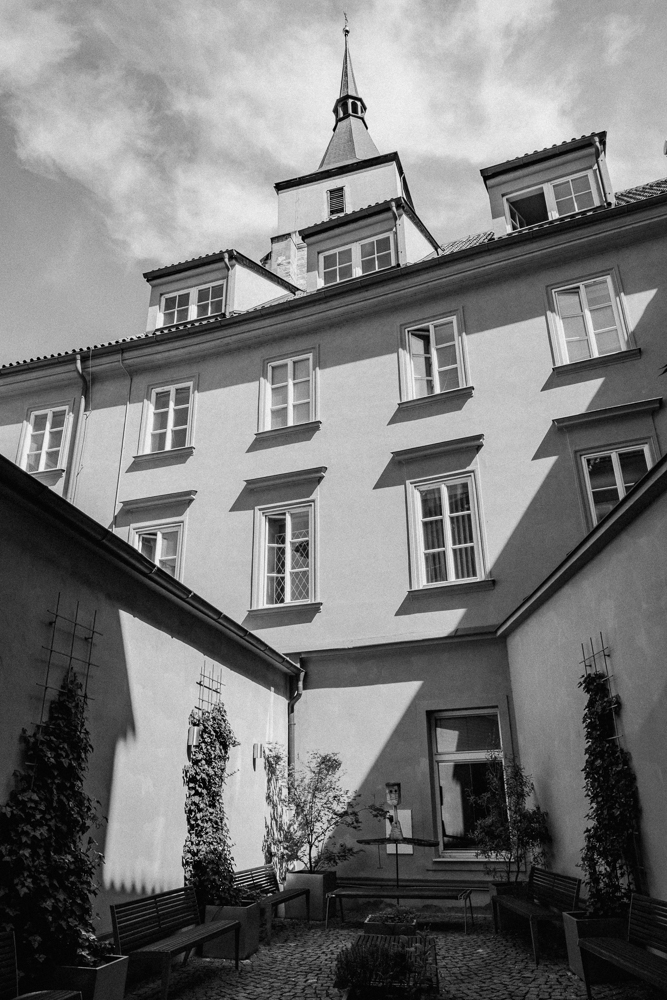
CfP for the "After Industry: Cities and Regions in Transformation" conference
The international conference After Industry: Cities and Regions in Transformation will focus on the transformations of cities and regions in the post-industrial era. It will take place on 14–15 May 2026 in Prague as part of the project Urbanity: Inequality, Adaptation, and Urban Public Space in Historical Perspective. The deadline for paper submissions is 30 June 2025. More information
- 24. 4. 2025
- Call for papers